Translate

Affichage des articles dont le libellé est nuclear power station. Afficher tous les articles

lundi 17 avril 2017

Fessenheim nuclear plant shut down: the pros and cons.

Nuclear power station shut down in France: rather for political reasons or technical ones?
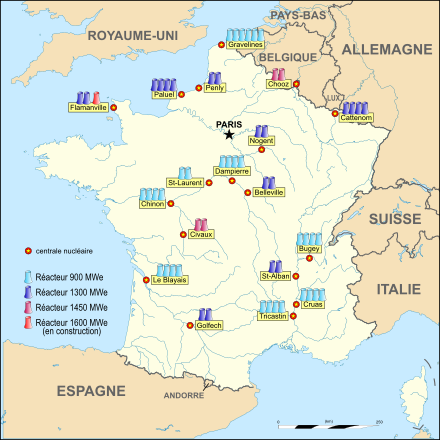
Map of French nuclear stations


Here are the parameters of the situation:


The nuclear power station of Fessenheim (Eastern France) is the oldest one of the French nuclear park (the old lady will compute 40 years of production in 2017). As such, it was considered to be the first to be closed in the wake of a green energy transition period. Nevertheless, EDF, Électricité de France, the operating utility, gathered its board of Directors in order to take a decision about the station decommissioning on April 6th.
The final decision was to postpone the closure after the commissioning of Flamanville EPR nuclear station (in Normandy, West of France), in order to avoid to produce less than the  63,2 GW limit set in the 2015 energy transition law. Though technical delays, this commissioning is still scheduled for late 2018. Moreover, the decision gives EDF the possibility to choose to close either the Fessenheim station or another one.

Nevertheless, the Fessenheim closure is still a thorny issue in a blurred political electoral campaign, but also for economic reasons.


Why all this fuss and this open opposition between EDF and the French government?


First, the closure was an electoral promise of presidential candidate Hollande
As soon as he expressed his idea, a lot of counter-measures were launched at a missile speed, the first being the job impact on the local area: indeed 2,000 workers are directly or indirectly involved in the nuclear plant. So what? 2,000 jobseekers more in a context where the joblessness is still skyrocketing?

Second, still on the political ground. in 2015, the law on energy transition was adopted. This law stipulates that the nuclear part in the French energy mix should be reduced from 75% to 50%. That’s implying that several power stations should be closed. But it implies moreover that the possibility of growth of EDF shall be sharpened widely. That’s a perspective that no company would accept easily, for the simple reason that the obvious aim of everybody’s company is to expand and expand its revenues.


What are the economic consequences of the Fessenheim closure?


Beyond the 2,000 positions jeopardised by the closure, here are some financial figures which may need a thorough analysis.
Indeed the power station delivers some €400 million of Ebitda, depending on the power wholesale prices.
Then, what is not so much emphasized in the public media, a third of Fessenheim station production is allocated to minority shareholders, mainly from Germany and Switzerland: EnBW, Alpiq, Axpo and BKW (they account for 15% of the capital of the power station), to pay for their minority stakes in the capital.

So, these financial parameters entail a compensation to be paid to EDF in case of closure, as a kind of damage: some €490 million shall be paid when both reactors will be shut down (normally in 2019 and 2021), with an adjustment made depending on power market price, until 2041.

Fessenheim power station, what is it?
The power station is composed of two reactors of 900MW each.
The station is located in an area considered as presenting seismic exposure and exposure to floods.
The staff accounts for 750 workers but gives work to some 1,250 more among contractors and
regional local firms.


EDF: a state company or an hybrid monster? 


You already know the hybrid vehicles but you don’t know what is a hybrid monster in the field of companies and societies…

The negotiations around Fessenheim closure highlight several judicial, economic and regulatory points which may be difficult to understand abroad.

Even if the French State is EDF’s main shareholder (its stake amounts to 85% of the capital), the State was unable to compel the company to abide by the presidential promise to shut down Fessenheim station. This promise was only words. Why? Because a president can’t decide by himself to close this or that: only the operator (here: EDF) or the ASN (the French nuclear watchdog) can apply a request for closure, either for lack of profitability or for security reasons (in the ASN case). The request procedure is really long and difficult.
Moreover, as a stakeholder, the State has appointed six administrators in EDF                                                                         board of Directors. But during the sessions, it’s forbidden for the State to vote when it is involved as a party in the negotiations. So its six administrators could not take part in the votes and decisions. Only the staff representing administrators and the independent ones remain able to vote, which make the final decisions really uncertain.
Then, when the president decided to reduce the part of nuclear generation in the energy mix from 75% to 25%, the law corresponding to this was amended several times, only to conclude that the part of the nuclear generation should not be above the present production, namely 63,2 GW, and EDF is interpreting this threshold not as a roof but as a bottom line.
Finally the implementation of an energy multi-year planning reportedly designed to pilot the State action in the energy field was not awarded to any ministry but to… EDF.

The Fessenheim case illustrates several dysfunctions: during five years, 2,000 jobs have been threatened by a possible closure. It’s simply non-economical.
Moreover during the discussions, the possible setting of a nuclear dismantling sector or the industrial future of the nuclear sites have never been considered.

From Véronique LeBillon and Anne Feitz, « Les Échos »


vendredi 27 janvier 2017

At Hinkley Point EPR site, Father Christmas has brought a fabulous gift to civil works operator Bouygues: some €1,7 billion.

Hinkley Point EPR site will award to Bouygues, the French civil works operator, some €1,7 billion.

source: EDF


EPR construction represents a kind of gigantic scale. Beside being France’s nuclear nec plus ultra, the site intends to become EDF’s window in the field of nuclear power stations.

Now, the proportion of Bouygues’ share in this agreement concluded in 2014 has been identified surely to amount to €1,7 billion. In fact, Bouygues is a partner of the British Laing O’Rourke in the Bylor consortium. The joint-venture won the tender in 2014.

Therefore, Bouygues’ order book has got a fabulous gift from Father Christmas: around €1,7 billion for the construction of the buildings containing both EPR. The joint-venture, composed of Laing O’Rourke and Bouygues, were awarded the construction for Hinkley Point C in last October 2014. But this amount couldn’t  enter Bouygues’ financial statements as it was not really effective, as the joint-venture has to calculate which part was to be allocated to the French partner.
At the beginning, , the part of civil works of the nuclear power station was around £2 billion (namely €2,3 billion) but the figure changed since then.
In a press release, Bouygues has reminded that « Hinkley Point C power station will produce some 2,3 gigawatt. Moreover, it will deliver power to more than 5 million households, accounting for 7% of the total power consumption of the United Kingdom ». The project shall manage some 3,500 workers at the summit of activity.

A third contract for an EPR power station

Hinkley Point C shall be commissioned in 2025. This agreement is the third of the kind to be awarded to Martin Bouygues’ company for nuclear power stations using the new EPR technology (European pressurized reactors). Bouygues has been already chosen by Areva to build the Finnish Olkiluoto station in 2005, then by EDF for the French Flamanville station in 2006. Before, the company was involved in second-generation power stations construction in France, such as Bugey, Saint-Alban and Chooz.
But Olkiluoto as Flamanville have recorded delays and impressive overcosts. Both sites seem to concentrate incidents.

For instance, in Olkiluoto, even if civil works are not involved in the present disputes, the site has recorded a nine-years’ time delay and overall invoice has increased from €3,5 billion to €8 billion. The dispute between Areva and TVO, its Finnish client, is still waiting for decision in the hand of the International Arbitration Court, which may issue a decision this year… or in 2018. TVO claims for €2,6 billion of penalties, whereas Areva claims for €3,4 billion of damages.

Some budget deficits were seen also on Flamanville site and the total amount of invoice has more than tripled to reach some €10,5 billion. Suffering from various faulty procedures, a new one has emerged recently: the problem of carbon concentration in the tank and the lid of the reactor tank, built in Areva’s Le Creusot site. The Authority for Nuclear Safety ( the French nuclear watchdog) has required several sets of tests. This institution shall take a final decision at the end of first semester.

Gigantism of the figures, of the number of people involved, of ambitions.

Read further:


vendredi 14 novembre 2014

NUCLEAR GOES EAST

<script>
  (function(i,s,o,g,r,a,m){i['GoogleAnalyticsObject']=r;i[r]=i[r]||function(){
  (i[r].q=i[r].q||[]).push(arguments)},i[r].l=1*new Date();a=s.createElement(o),
  m=s.getElementsByTagName(o)[0];a.async=1;a.src=g;m.parentNode.insertBefore(a,m)
  })(window,document,'script','//www.google-analytics.com/analytics.js','ga');

  ga('create', 'UA-57622142-1', 'auto');
  ga('send', 'pageview');


</script>
Nuclear centre of gravity goes East

From les Échos 13/11 Véronique Lebillion
·       

This figure shows an apparent stability, which hides major evolutions. By 2040, nuclear share in power generation will rise by 1%, to reach an overall 12%, according to the main scheme published Wednesday by the IAEA. Taking into account the increase of global power demand (namely 2,1% yearly), this stability means an increase of nearly 60% of the installed nuclear power, corresponding to 624 gigawatt (GW) to be compared with 392 GW last year. Above all, nuclear geography will experience major changes: in China, installed capacities will be multiplied by ten, to 149 GW, corresponding to nearly a quarter of the global installed capacity in 2040.
Thus the IAEA report confirms the switch of the nuclear generation capacity towards East: whereas the United States would record a slow growth, the European Union (together with Japan) would be the sole area where atom would record a decline (-14%). In Europe, nuclear share of power generation would decrease from 27% to 21% over the time considered. Moreover, there is a major issue: if the main part of nuclear countries extends the lifespan of their infrastructures commissioned in the seventies and eighties, 200 on the 434 reactors now operated in the world would be in course of dismantling by 2040, writes the IAEA.


Several stakes
These assessments won’t be enough to contain global warming, regrets the agency, which adds that the nuclear park has avoided the equivalent of two years of carbon emissions since 1971. But nuclear arouses many problems, among which the acceptation by public opinion and financing of the stations, which is very capitalistic. “Nuclear generation is a major option to generate power, with no carbon emission and without intermittence. The bearish tendency in Europe should question these countries about the way to balance it”, says Fatih Birol, chief economist of the IAEA.
The number of countries operating nuclear power generation should climb from 31 in 2013 to 36 in 2040, included those which announced their coming out from atom (Germany, Switzerland and Belgium). Among the forty countries having expressed interest for a first nuclear station, fifteen have a network size and an economic weight corresponding to the required investments, writes the IAEA.