Translate

Affichage des articles dont le libellé est nuclear power plants. Afficher tous les articles

lundi 17 avril 2017

Fessenheim nuclear plant shut down: the pros and cons.

Nuclear power station shut down in France: rather for political reasons or technical ones?
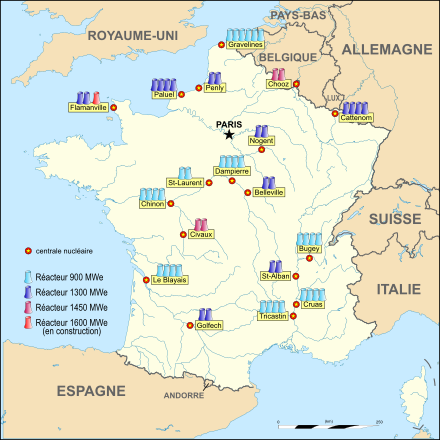
Map of French nuclear stations


Here are the parameters of the situation:


The nuclear power station of Fessenheim (Eastern France) is the oldest one of the French nuclear park (the old lady will compute 40 years of production in 2017). As such, it was considered to be the first to be closed in the wake of a green energy transition period. Nevertheless, EDF, Électricité de France, the operating utility, gathered its board of Directors in order to take a decision about the station decommissioning on April 6th.
The final decision was to postpone the closure after the commissioning of Flamanville EPR nuclear station (in Normandy, West of France), in order to avoid to produce less than the  63,2 GW limit set in the 2015 energy transition law. Though technical delays, this commissioning is still scheduled for late 2018. Moreover, the decision gives EDF the possibility to choose to close either the Fessenheim station or another one.

Nevertheless, the Fessenheim closure is still a thorny issue in a blurred political electoral campaign, but also for economic reasons.


Why all this fuss and this open opposition between EDF and the French government?


First, the closure was an electoral promise of presidential candidate Hollande
As soon as he expressed his idea, a lot of counter-measures were launched at a missile speed, the first being the job impact on the local area: indeed 2,000 workers are directly or indirectly involved in the nuclear plant. So what? 2,000 jobseekers more in a context where the joblessness is still skyrocketing?

Second, still on the political ground. in 2015, the law on energy transition was adopted. This law stipulates that the nuclear part in the French energy mix should be reduced from 75% to 50%. That’s implying that several power stations should be closed. But it implies moreover that the possibility of growth of EDF shall be sharpened widely. That’s a perspective that no company would accept easily, for the simple reason that the obvious aim of everybody’s company is to expand and expand its revenues.


What are the economic consequences of the Fessenheim closure?


Beyond the 2,000 positions jeopardised by the closure, here are some financial figures which may need a thorough analysis.
Indeed the power station delivers some €400 million of Ebitda, depending on the power wholesale prices.
Then, what is not so much emphasized in the public media, a third of Fessenheim station production is allocated to minority shareholders, mainly from Germany and Switzerland: EnBW, Alpiq, Axpo and BKW (they account for 15% of the capital of the power station), to pay for their minority stakes in the capital.

So, these financial parameters entail a compensation to be paid to EDF in case of closure, as a kind of damage: some €490 million shall be paid when both reactors will be shut down (normally in 2019 and 2021), with an adjustment made depending on power market price, until 2041.

Fessenheim power station, what is it?
The power station is composed of two reactors of 900MW each.
The station is located in an area considered as presenting seismic exposure and exposure to floods.
The staff accounts for 750 workers but gives work to some 1,250 more among contractors and
regional local firms.


EDF: a state company or an hybrid monster? 


You already know the hybrid vehicles but you don’t know what is a hybrid monster in the field of companies and societies…

The negotiations around Fessenheim closure highlight several judicial, economic and regulatory points which may be difficult to understand abroad.

Even if the French State is EDF’s main shareholder (its stake amounts to 85% of the capital), the State was unable to compel the company to abide by the presidential promise to shut down Fessenheim station. This promise was only words. Why? Because a president can’t decide by himself to close this or that: only the operator (here: EDF) or the ASN (the French nuclear watchdog) can apply a request for closure, either for lack of profitability or for security reasons (in the ASN case). The request procedure is really long and difficult.
Moreover, as a stakeholder, the State has appointed six administrators in EDF                                                                         board of Directors. But during the sessions, it’s forbidden for the State to vote when it is involved as a party in the negotiations. So its six administrators could not take part in the votes and decisions. Only the staff representing administrators and the independent ones remain able to vote, which make the final decisions really uncertain.
Then, when the president decided to reduce the part of nuclear generation in the energy mix from 75% to 25%, the law corresponding to this was amended several times, only to conclude that the part of the nuclear generation should not be above the present production, namely 63,2 GW, and EDF is interpreting this threshold not as a roof but as a bottom line.
Finally the implementation of an energy multi-year planning reportedly designed to pilot the State action in the energy field was not awarded to any ministry but to… EDF.

The Fessenheim case illustrates several dysfunctions: during five years, 2,000 jobs have been threatened by a possible closure. It’s simply non-economical.
Moreover during the discussions, the possible setting of a nuclear dismantling sector or the industrial future of the nuclear sites have never been considered.

From Véronique LeBillon and Anne Feitz, « Les Échos »


mardi 11 novembre 2014

<script>
  (function(i,s,o,g,r,a,m){i['GoogleAnalyticsObject']=r;i[r]=i[r]||function(){
  (i[r].q=i[r].q||[]).push(arguments)},i[r].l=1*new Date();a=s.createElement(o),
  m=s.getElementsByTagName(o)[0];a.async=1;a.src=g;m.parentNode.insertBefore(a,m)
  })(window,document,'script','//www.google-analytics.com/analytics.js','ga');

  ga('create', 'UA-57622142-1', 'auto');
  ga('send', 'pageview');


</script>
From "Les Échos" 10/11/2014

About drones : MP put the question of drone presence over the nuclear plants on their agenda
ANNE FEITZ /REPORTER/ ON 10/11 AT 06 :00, UPDATED AT 10 :12
Saturday, the Bugey power plant filed a claim after the fourth drone flying over of its site on Thursday. – François HENRY/REA
The MP Commission about assessment of scientific and technologic issues will organize a public session about plants flying over in late November.
Whereas a nineteenth drone flying over a nuclear plant was recorded this week end, PM decided to refer the problem to the Assemblée Nationale (French lower Chamber of Representatives).  The MP Commission about evaluation of scientific and technologic issues (Opecst, French acronym) will thus organize a public session about plants flying over and its possible threats, about the means to be implemented to cope with it and targeted at the coordination to be put in place in nuclear security and safety. « Now it becomes urgent to stop these disorders », said PS MP Jean-Yves Le Déaut. « These actions and their instigators are irresponsible. They probably intend to show that plants are not safe. »
Since the beginning of October, 19 plants drone flying over were publicly recorded. Saturday, the Bugey plant filed a claim after being flied over for the fourth time on Thursday. Marcoule, Saint-Alban, Creys-Malville, Blayais, Nogent-sur-Seine, Cattenom, Chooz, or Gravelines have also recorded « the illegal presence of aircrafts similar to drones », whereas flying over a plant has been banned in a 5 km perimeter and a 1,000 m of height above sites.

State’s uneffectiveness to stop this situation
Last week, two men were put in investigation and set under judicial control because they flied drones not far from Belleville-sur-Loire plant : they were fans of model buildings without any terrorist or protest claim, said the Republic General Attorney in Bourges.
Whereas EDF and the State insist that these flying over do not set any imminent danger, their uneffectiveness to put an end to this situation arouses MP’s concerns. Greenpeace denied any implication. It made a drone fly over La Hague in 2012 then used a paramotor above Bugey. The association denies any implication since the beginning of this wave of flying over. But the NGO is concerned about « the State’s uneffectiveness to stop these flying over », recording for its part that  «  there is a real threat, particularly about irradiated fuel stored pools » . 

En savoir plus sur http://www.lesechos.fr/journal20141110/lec2_entreprise_et_marches/0203925974723-drones-les-parlementaires-se-saisissent-de-la-question-des-survols-de-centrale-1062737.php?vFrAsYr5FfAMqqSG.99


lundi 10 novembre 2014

Drones over nuclear plants: EDF and the State are looking for a counterattack


<script>
  (function(i,s,o,g,r,a,m){i['GoogleAnalyticsObject']=r;i[r]=i[r]||function(){
  (i[r].q=i[r].q||[]).push(arguments)},i[r].l=1*new Date();a=s.createElement(o),
  m=s.getElementsByTagName(o)[0];a.async=1;a.src=g;m.parentNode.insertBefore(a,m)
  })(window,document,'script','//www.google-analytics.com/analytics.js','ga');

  ga('create', 'UA-57622142-1', 'auto');
  ga('send', 'pageview');

</script>
From "les ÉCHOS"

Drones : EDF and the State are looking for a counter attack
VERONIQUE LE BILLON DEPUTY HEAD OF SERVICE – OCTOBER, 30TH AT 18:12, UPDATED AT 18:29
•
Recently, on its Website, EDF mentioned several claims after tracking “ the illegal presence of an aircraft comparable to a drone” on several nuclear sites, Bugey (above) included – Laurent CERINO/REA
1 / 1
In October, drones have flown over several nuclear sites of EDF and CEA (Atomic Energy research centre).  This situation puts EDF and the State under pressure: regulations need to be implemented.
As unknown drones have flown over several nuclear stations during last week, EDF and the government are put under pressure. « There is a judicial investigation in course, there are some provisions to know and there are existing provisions to neutralize these drones », said Bernard Cazeneuve, the Interior Minister to France Info radio on Thursday.
Recently, on its Website, EDF mentioned several claims after tracking “ the illegal presence of an aircraft comparable to a drone” over several nuclear sites, (Creys-Malville, Blayais, Nogent-sur-Seine, Cattenom, Chooz, Gravelines and Bugey) between October 5 and 24th.  The same happened over infrastructures of the CEA. This makes advertisement not very appreciated by the Ecology Ministry, where the economic security and defense watch office is located.  « We don’t perceive this fact as an imminent danger, but we don’t want that other people make fun in doing this », said someone.


Flying over nuclear centres is forbidden in a 5 km perimeter and at a 1,000m height above the sites. Greenpeace denied any implication. It made a drone fly over La Hague in 2012 then used a paramotor above Bugey.
“No intelligence – acquainted operator”
The State shall bear the main role in this situation. Each power station has on site a group of 38-50 military police « gendarmes ». « The role of intelligence and fight against an aggressor are central State’s visi e misi. We don’t want to see intelligence-acquainted operator », said the Energy Minister. Taking to the force won’t be a favored option. « We don’t know where the drone would crash neither the location where these engines will finish their run. The engine’s capacity is low, it’s not worth taking to the force ». Detecting the pilots is the favored priority.
Moreover several night observations may have been confused with planes, said the ministry. Officially speaking, this new episode highlighted the delays observed in the safety enforcement of the sites. In 2009, the State gave to the nuclear operators (namely EDF, Areva and the CEA) several  « obligations to achieve a result towards reference threats ». Some studies are pending, whereas the reinforcement of infrastructure (such as detection means, wire fencing, reinforced doors…) shall be effective in late 2016. On its part, EDF advocates for strengthening the criminal sanctions and proceedings against legal entities in case of intrusion. This summer, a law was draft to be adopted in an order, before being put off. This draft may be taken in a future law on interior security.
As progress is expected about the power and the remote control of drones, used by EDF to watch its infrastructures, an inter-ministerial group has been nominated. There is no such event in Europe, thus the ministry has requested from some sensible sites operators, to inform it about any similar fact (for instance, refineries).
@VLeBillon

En savoir plus sur http://www.lesechos.fr/industrie-services/energie-environnement/0203901905291-drones-edf-et-letat-cherchent-la-riposte-1059304.php?Jt4x1XG3ZzUjPely.99